Seal the ground,
and the house dries out.
Crawl space encapsulation, vapor barriers, dehumidification, and moisture control across Sussex County, Delaware — done to the code your county actually enforces.
Most crawl space problems
are one problem.
Bare soil under a house never stops giving off moisture. In a vented crawl space, humid outside air is invited in to carry it away — which works in a dry climate and fails in ours. Warm coastal air meets cool crawl space surfaces, condenses on joists and ductwork, and the space that was supposed to dry out becomes the wettest part of the building.
Encapsulation reverses the logic. Instead of ventilating moisture out, you stop it at the ground with a sealed barrier and then control what humidity remains. Done properly it is not a plastic sheet thrown over dirt — it is a continuous, sealed, mechanically controlled system, and the building code spells out exactly what that means.
What it looks like from upstairs.
Homeowners rarely call about a crawl space. They call about something happening in the rooms above it.
A musty smell you cannot locate
Air moves upward through a house. A large share of the air you breathe on the first floor started in the crawl space, and it carries whatever is growing down there with it.
Floors that feel cold, soft, or springy
Subfloor absorbing moisture from below loses stiffness. Sagging between joists and a spongy feel underfoot usually start as a humidity problem, not a framing one.
Insulation on the ground
Fiberglass batts stapled between joists absorb moisture, gain weight, and eventually fall. If yours are hanging or lying in the dirt, the space has been wet a long time.
Condensation on ducts or pipes
Cool metal in humid air sweats. That water drips onto joists and soil, feeding the same cycle that put it there.
Summer allergies that ease when you leave
Symptoms tied to the building rather than the season point toward what the air is carrying, and the crawl space is the most common untreated source.
Standing water after heavy rain
Common across low-lying Sussex County. Encapsulation alone will not fix it — drainage has to be solved first, or the barrier simply floats.
What the code actually requires.
Sussex County Council adopted the 2021 International Residential Code, Chapters 1 through 10, effective January 1, 2023. Crawl spaces fall under Section R408. An unvented, sealed crawl space is explicitly permitted — but only when specific conditions are met.
Unvented crawl space, by the book.
To legally remove the foundation vents, the code requires a continuous Class I vapor retarder over all exposed earth, plus one approved method of conditioning the space. These are minimums, not targets.
On the exhaust and supply options the code sets the rate at 1 cubic foot per minute for every 50 square feet of crawl space floor area, with an air pathway to the common area and insulated perimeter walls. We size every system to the space rather than to a rule of thumb.
Two details matter more than homeowners expect. Six-mil polyethylene is the thinnest material that satisfies a Class I vapor retarder, and it is not built to survive being walked on, dragged across, or left exposed for years — which is why we install heavier reinforced barriers rather than the code minimum. And the sealing is the job. An unsealed barrier laid loose over dirt is not encapsulation; it is a tarp.
Why the beach towns are different.
From Lewes down through Fenwick Island, a large share of homes sit in FEMA-mapped flood zones. Under an elevated house, the crawl space is a flood enclosure first, and federal flood-resistant construction standards require openings that let floodwater pass in and out on its own — generally at least one square inch of opening per square foot of enclosed area, with the bottom of each opening no more than one foot above grade. Sussex County administers those standards locally through its Flood-Prone Districts ordinance, and your exact requirement should be confirmed with the County floodplain administrator.
That requirement does not disappear because a homeowner wants a sealed crawl space. It means the moisture strategy has to work with the flood openings rather than by closing them, using a fully sealed ground barrier, appropriate materials below the flood elevation, and dehumidification sized for a space that cannot be made airtight. Simply covering the vents creates a code violation and a potential problem at the next flood insurance review.
Twenty minutes inland, in Georgetown or Laurel, none of that applies and the space can be closed conventionally. Same county, two different jobs. That distinction is the reason we quote coastal and inland crawl spaces differently.
Six stages, in order.
Inspection and moisture reading
We go under the house. Wood moisture content, relative humidity, standing water, drainage, insulation condition, pest damage, duct and plumbing leaks, and any existing mold growth all get recorded before a price is discussed.
Fix the water source first
Grading, downspouts, a failed sump, a leaking supply line. Sealing a crawl space over an active water problem traps it. If we find one, it gets corrected before anything is installed — and if that changes the scope, you hear it before we start.
Clear out and treat
Fallen insulation, debris, and construction leftovers come out. Where mold is present, the space is treated under containment before it gets sealed in. Encapsulating over active growth is the single most common mistake we are called in to undo.
Install the barrier
Reinforced vapor barrier across all exposed earth, seams overlapped and sealed, edges carried up the stem wall and mechanically fastened, piers and penetrations wrapped and sealed individually.
Control the remaining humidity
A sealed barrier stops ground moisture but not what the air already holds. We size and install the conditioning method the code allows for your house, then verify the space actually holds below the target rather than assuming it will.
Document and hand off
Before and after photographs, moisture readings, and a written description of what was installed. Useful at resale, at a home inspection, and for any insurance conversation later.
Sealed crawl spaces across the county.
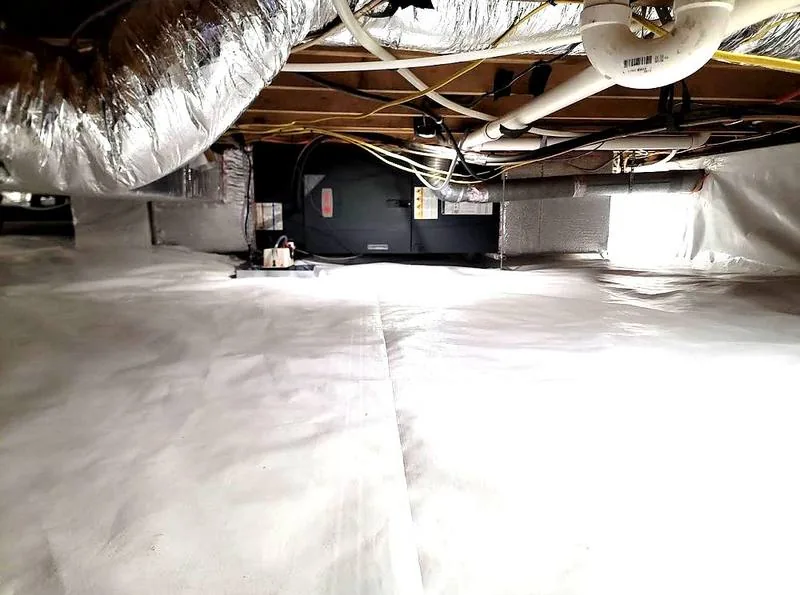
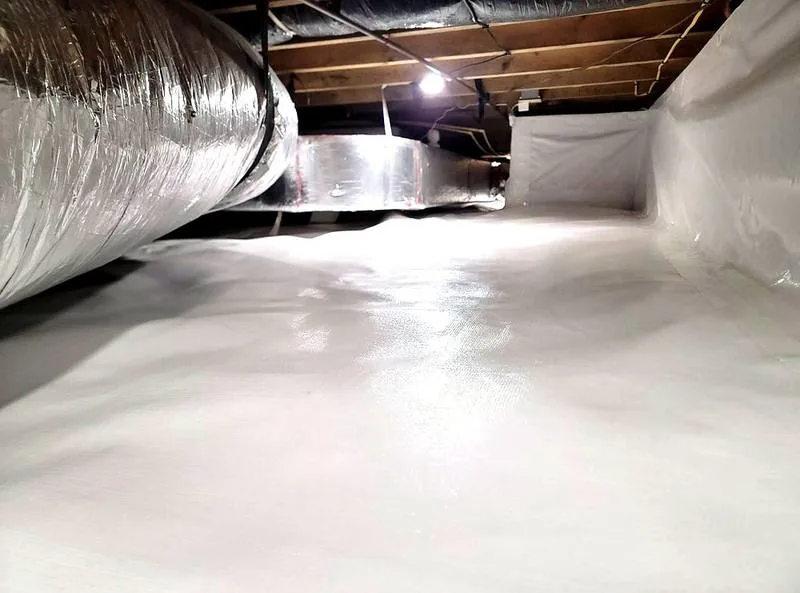
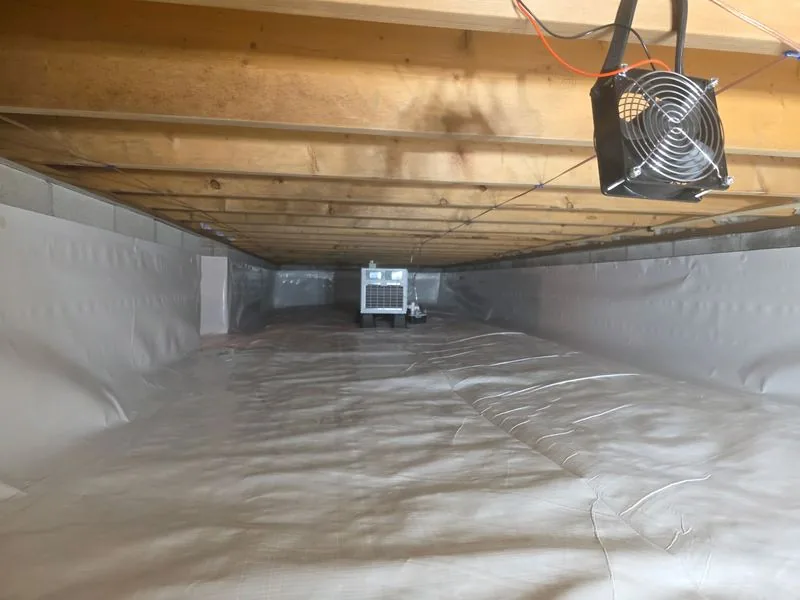
What homeowners ask us first.
What does crawl space encapsulation cost in Sussex County?
It depends on square footage, current condition, and whether the space needs drainage or mold work before it can be sealed. A clean, dry, average-sized crawl space is a straightforward job. One with standing water, fallen insulation, and active growth is three jobs stacked together. We will not quote a number over the phone without seeing the space, because a guess that is wrong helps neither of us. Every on-site estimate is free.
Is encapsulation worth it, or is it a sales pitch?
It is worth it when there is a moisture problem, and it is not when there is not. A dry, well-drained crawl space with an intact barrier and no humidity issue does not need to be encapsulated, and we will tell you that. Where it earns its keep is the situation we run into constantly here: a vented crawl space in a humid coastal climate, sitting well above the humidity level the EPA recommends for months at a time, with that air moving up into the house.
Can I just put plastic down myself?
You can, and it will help a little. But loose plastic is not what the code describes. R408.3 requires joints overlapped six inches and sealed or taped, edges carried six inches up the stem wall and attached and sealed, and an approved conditioning method for the space. Skipping the sealing and the conditioning is what separates a tarp from an encapsulation, and it is why so many partially done crawl spaces still smell.
Do I need a dehumidifier if the crawl space is sealed?
You need one of the conditioning methods the code allows — continuous mechanical exhaust, a conditioned air supply, a plenum arrangement, or dehumidification. Sealing the ground stops moisture coming up from the soil, but it does not remove the moisture already in the air or anything introduced later by a leak. In this climate, dehumidification is usually the most practical of the four.
My house is in a flood zone. Can it still be encapsulated?
Yes, but not by closing the vents. Flood-resistant construction standards call for openings that allow floodwater to flow in and out on its own — generally one square inch per square foot of enclosed area, with the bottom of each opening no more than a foot above grade. Sussex County administers these locally, so confirm your specific requirement with the County. The moisture strategy has to work around those openings using a fully sealed ground barrier and dehumidification sized for a space that cannot be airtight. Covering the flood vents is not an option here — it creates a code problem on top of the moisture one.
What if there is already mold down there?
It gets remediated before anything is sealed. Encapsulating over active growth traps it against the wood and hides it from view while it continues. We handle remediation and encapsulation as one project so there is no gap between the two and no second contractor to coordinate.
How long does the work take?
A typical encapsulation is a multi-day project. Add drainage correction or mold remediation and it grows from there. You will get a realistic schedule with the estimate, and if something under the house changes the plan, you hear about it that day rather than at the end.
Do you serve my town?
We are based in Dagsboro and work across all of Sussex County — the beach towns, the bay and waterfront communities, and inland from Georgetown out to the Maryland line. If your town is inside the county line, the answer is yes.